AGENT-READY PRD / WORKFLOW KIT
AI PM Workflow Kit.
An agent-ready PRD template, agent context files, and 8 Claude Code skills for PMs using Claude Code, Cursor, or Codex.
AI PM Workflow Kit is a downloadable folder of Markdown files you copy into your repo. It gives the agent a spec it can test against, keeps it inside the scope you set, and sends the judgment calls back to you: the problem, the non-goals, and which critique findings to accept.
This is a paid template. This page only describes it; the Markdown files and PDFs are delivered by Gumroad after purchase. Listed at $29 as a one-time purchase. See Gumroad for the current price. It pairs with Product Manager OS: link each PRD from its roadmap item and record big scope calls in the Decision Log. For the research before a PRD, see the Discovery & User Interview Kit. There is no automatic sync, and each product is sold separately.
What's inside
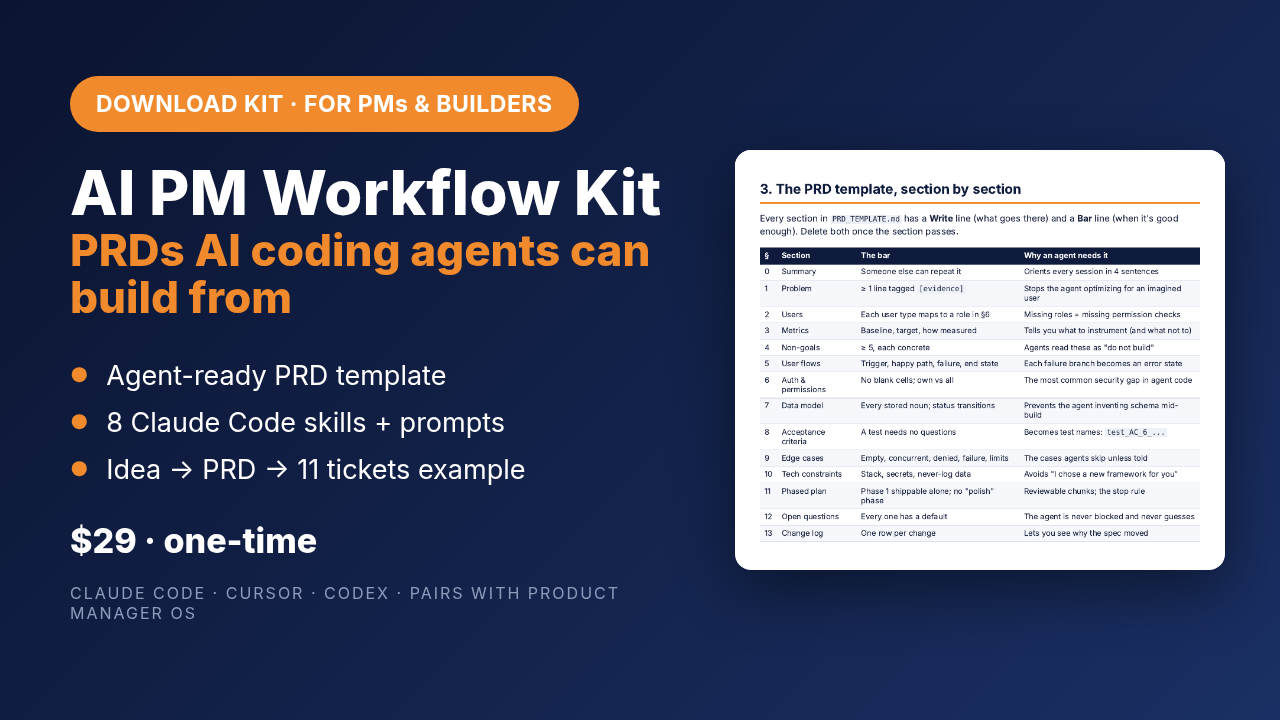
An AI-builder PRD template in Markdown, with 13 sections: problem with evidence tags, users, metrics, non-goals, user flows with failure branches, an auth and permission table, a data model with status transitions, testable acceptance criteria, edge cases, tech constraints, a phased build plan, open questions with defaults, and a change log. Agent context starters: CLAUDE.md, AGENTS.md, and 2 Cursor rules (.mdc) that point every session at your PRD and its current phase. 8 Claude Code skills as SKILL.md folders, plus the same 8 as plain prompts for ChatGPT, Cursor chat, or Codex: /scope-questions, /interview-synthesis, /rice-score, /prd-critique, /edge-case-finder, /prd-to-tickets, /stakeholder-update, /release-notes. A worked example, SwapShelf, a fictional neighborhood tool-lending app, taken from a one-line idea through 3 scope questions, a critique (including suggestions the human rejected), an 18-acceptance-criteria PRD, and 11 phased tickets with an acceptance-criteria coverage table. Also a 2-page Human Review Checklist (Markdown and printable PDF), a 12-page PDF guide, and a README with a 30-minute Quick Start.
Why it is different from a prompt pack
Each of the 13 PRD sections has a Write line and a Bar line, so you know when a section is good enough. Numbered Given/When/Then acceptance criteria become test names. Non-goals become hard constraints. A phased plan with a stop rule keeps each change small enough to review. Every skill has to quote your PRD, a participant id, or a ticket id. Guesses get labeled, and when an input is missing the skill asks for it. The 2-page checklist covers the parts AI cannot know, including a "swap in a competitor's name" test for generic PRDs.
Who it's for
PMs prototyping or shipping features with Claude Code, Cursor, or Codex. Indie builders and founders who plan before they prompt. PMs handing specs to engineers who use coding agents. Product Manager OS users who want roadmap items to turn into buildable specs.
Scope and format
A .zip of Markdown files plus PDFs (guide and checklist). Open the Markdown in VS Code, Cursor, Obsidian, or GitHub. The skills run as slash commands in Claude Code. Every skill also comes as a plain prompt you can paste into ChatGPT, Claude.ai, Cursor, or Codex, and the template and checklist need no AI at all. You do not need to be an engineer. You will need to run commands an agent gives you and click through what it builds, and every ticket includes a 2-minute manual check. It helps you draft, critique, and slice a PRD. On purpose, it leaves the problem, the non-goals, and the final decisions to you. For a feature in an existing product, use the same template and list the files and patterns the agent must follow in the tech-constraints section. SwapShelf is fictional, including the people and numbers. This is not an official Anthropic, Cursor, or OpenAI product. It is a one-time purchase, not a subscription.
A closer look